# Zabbix GraphQL API
A GraphQL wrapper for the Zabbix API that provides enhanced mass import/export operations, hierarchical host group management, and dynamic schema extensibility. Built with Apollo Server, TypeScript, and ES modules.
## 🚀 Features
- **GraphQL Interface**: Modern GraphQL API wrapping Zabbix functionality
- *Reference*: `schema/queries.graphql`, `schema/mutations.graphql`, `src/api/start.ts`
- **Hierarchical Data Mapping**: Automatic mapping of Zabbix items/tags to nested GraphQL objects
- *Reference*: `src/api/resolver_helpers.ts`, `schema/device_value_commons.graphql`, `docs/sample_all_devices_query.graphql`
- **Mass Operations**: Import/export capabilities for hosts, templates, and user rights
- *Reference*: `schema/mutations.graphql` (importHosts, importTemplates, importUserRights, etc.), `docs/sample_import_*.graphql`
- **Dynamic Schema Extension**: Extend the schema without code changes using environment variables
- *Reference*: `src/api/schema.ts`, `schema/extensions/`, `src/common_utils.ts` (ADDITIONAL_SCHEMAS, ADDITIONAL_RESOLVERS)
- **Permission System**: Role-based access control using Zabbix template groups
- *Reference*: `schema/api_commons.graphql` (Permission enum, PermissionRequest), `src/api/resolvers.ts` (hasPermissions, userPermissions), `docs/sample_import_permissions_template_groups_mutation.graphql`
- **Real-time Subscriptions**: WebSocket support for GraphQL subscriptions (infrastructure implemented, but no actual subscriptions defined in schema)
- *Reference*: `src/api/start.ts` (WebSocketServer integration with `graphql-ws`), `AGENTS.md` (mentions WebSocket support), `package.json` (graphql-ws, subscriptions dependencies)
- **Type Safety**: Full TypeScript support with generated types
- *Reference*: `codegen.ts`, `src/schema/generated/graphql.ts`, `tsconfig.json`, `package.json` (devDependencies for GraphQL Codegen)
## 📋 Prerequisites
Before you begin, ensure you have met the following requirements:
- **Node.js** >= 18.x (tested with v21.5.0)
- **NPM** >= 8.x
- **Zabbix Server** with API access
- **Zabbix Super Admin Token** (for full functionality)
## 🛠️ Installation
### Clone the repository
```bash
git clone https://github.com/your-repo/zabbix-graphql-api.git
cd zabbix-graphql-api
```
### Install dependencies
```bash
npm install
```
## ⚙️ Configuration
### Environment Variables
Create a `.env` file in the project root with the following variables:
```bash
# Zabbix connection
ZABBIX_BASE_URL=http://your-zabbix-server/zabbix
ZABBIX_AUTH_TOKEN=your-super-admin-token
ZABBIX_AUTH_TOKEN_FOR_REQUESTS=your-super-admin-token
# Optional configuration
ZABBIX_EDGE_DEVICE_BASE_GROUP=Roadwork
ZABBIX_ROADWORK_BASE_GROUP=Roadwork
ZABBIX_PERMISSION_TEMPLATE_GROUP_NAME_PREFIX=Permissions
SCHEMA_PATH=./schema/
# Dynamic schema extension (optional)
ADDITIONAL_SCHEMAS=./schema/extensions/display_devices.graphql,./schema/extensions/location_tracker_devices.graphql
ADDITIONAL_RESOLVERS=SinglePanelDevice,FourPanelDevice,DistanceTrackerDevice
# Logging
LOG_LEVELS=info
```
### Environment Variable Details
| Variable | Description | Default | Required |
|----------|-------------|---------|----------|
| `ZABBIX_BASE_URL` | URL to your Zabbix server (include `/zabbix` path) | - | Yes |
| `ZABBIX_AUTH_TOKEN` | Zabbix Super Admin API token for administrative operations (full permissions needed for import/export operations) | - | Yes |
| `ZABBIX_AUTH_TOKEN_FOR_REQUESTS` | Token used for automated requests (can be same as ZABBIX_AUTH_TOKEN or a different token with limited permissions for routine operations) | - | Yes* |
| `ZABBIX_EDGE_DEVICE_BASE_GROUP` | Base group for edge devices | - | No |
| `ZABBIX_ROADWORK_BASE_GROUP` | Base group for roadwork devices | - | No |
| `ZABBIX_PERMISSION_TEMPLATE_GROUP_NAME_PREFIX` | Prefix for permission template groups (used to identify permission-related template groups in Zabbix) | `Permissions` | No |
| `SCHEMA_PATH` | Path to schema files | `./schema/` | No |
| `ADDITIONAL_SCHEMAS` | Comma-separated list of additional schema files | - | No |
| `ADDITIONAL_RESOLVERS` | Comma-separated list of resolver types to generate | - | No |
| `LOG_LEVELS` | Log level configuration | - | No |
| `DRY_RUN` | If set, runs in dry run mode without starting the server (exits immediately after initialization, useful for testing configuration) | - | No |
| `HOST_TYPE_FILTER_DEFAULT` | Default filter for host types | - | No |
| `HOST_GROUP_FILTER_DEFAULT` | Default filter for host groups | - | No |
*Note: `ZABBIX_AUTH_TOKEN_FOR_REQUESTS` is required when different from `ZABBIX_AUTH_TOKEN`, otherwise the same token will be used for all operations.
### Authentication Tokens Explanation
The API supports two different authentication tokens for security separation:
- `ZABBIX_AUTH_TOKEN`: Used for administrative operations like import/export, requires Super Admin privileges
- `ZABBIX_AUTH_TOKEN_FOR_REQUESTS`: Used for routine read operations, can have limited permissions
### Edge Device Group Pattern
The `ZABBIX_EDGE_DEVICE_BASE_GROUP` (or `ZABBIX_ROADWORK_BASE_GROUP`) is used to create a regex pattern `FIND_ZABBIX_EDGE_DEVICE_BASE_GROUP_PREFIX` that identifies edge device groups in Zabbix. This pattern follows the format `^(${ZABBIX_EDGE_DEVICE_BASE_GROUP})\/` and is used to filter and process edge device related data.
### Configuration Examples
#### Development Configuration (.env.development)
```bash
# Zabbix connection
ZABBIX_BASE_URL=http://localhost:8080/zabbix
ZABBIX_AUTH_TOKEN=your-dev-super-admin-token
ZABBIX_AUTH_TOKEN_FOR_REQUESTS=your-dev-super-admin-token
# Optional configuration for development
ZABBIX_EDGE_DEVICE_BASE_GROUP=DevEdge
ZABBIX_ROADWORK_BASE_GROUP=DevRoadwork
ZABBIX_PERMISSION_TEMPLATE_GROUP_NAME_PREFIX=Permissions
SCHEMA_PATH=./schema/
LOG_LEVELS=debug
# Dynamic schema extension (optional)
ADDITIONAL_SCHEMAS=./schema/extensions/display_devices.graphql,./schema/extensions/location_tracker_devices.graphql
ADDITIONAL_RESOLVERS=SinglePanelDevice,FourPanelDevice,DistanceTrackerDevice
```
#### Production Configuration (.env.production)
```bash
# Zabbix connection
ZABBIX_BASE_URL=https://zabbix.company.com/zabbix
ZABBIX_AUTH_TOKEN=your-prod-super-admin-token
ZABBIX_AUTH_TOKEN_FOR_REQUESTS=your-prod-read-only-token
# Production configuration
ZABBIX_EDGE_DEVICE_BASE_GROUP=ProductionEdge
ZABBIX_ROADWORK_BASE_GROUP=ProductionRoadwork
ZABBIX_PERMISSION_TEMPLATE_GROUP_NAME_PREFIX=Permissions
SCHEMA_PATH=./schema/
LOG_LEVELS=info
# Dynamic schema extension for production
ADDITIONAL_SCHEMAS=/app/schema/extensions/display_devices.graphql,/app/schema/extensions/location_tracker_devices.graphql
ADDITIONAL_RESOLVERS=SinglePanelDevice,FourPanelDevice,DistanceTrackerDevice
# Performance and operational settings
HOST_TYPE_FILTER_DEFAULT=device
HOST_GROUP_FILTER_DEFAULT=production
```
## ▶️ Running the Application
### Development Mode
```bash
# Start with hot reloading
npm run start
```
The GraphQL API will be available at `http://localhost:4000/`
#### Available Queries and Mutations after start
#### Queries
- `apiVersion` - Returns the API build version
- `zabbixVersion` - Returns the version of the connected Zabbix instance
- `login` - Authenticates with Zabbix and returns an authentication token
- `logout` - Logs out from Zabbix, invalidating the current session
- `allHosts` - Returns all hosts and their items
- `allDevices` - Returns all devices and their items (hosts with deviceType)
- `allHostGroups` - Returns all host groups
- `locations` - Returns all locations used by hosts
- `exportHostValueHistory` - Exports value history for Zabbix items
- `userPermissions` - Returns all user permissions
- `hasPermissions` - Checks if the current user has requested permissions
- `exportUserRights` - Exports user rights (roles and groups)
- `templates` - Returns templates
- `allTemplateGroups` - Returns all template groups
#### Mutations
- `createHost` - Creates a single host in Zabbix
- `importHostGroups` - Mass import Zabbix host groups
- `importHosts` - Mass import hosts and assign them to host groups
- `importUserRights` - Import user rights (roles and groups) into Zabbix
- `importTemplateGroups` - Mass import template groups
- `importTemplates` - Mass import templates
- `deleteTemplates` - Delete templates by their IDs or by a name pattern
- `deleteTemplateGroups` - Delete template groups by their IDs or by a name pattern
### Production Build
```bash
# Compile TypeScript
npm run compile
# Run production build
npm run prod
```
### Available Scripts
| Script | Description |
|--------|-------------|
| `npm run start` | Start development server with hot reload |
| `npm run compile` | Compile TypeScript to JavaScript |
| `npm run prod` | Run production build |
| `npm run test` | Run tests |
| `npm run codegen` | Generate TypeScript types from GraphQL schema |
| `npm run nodemon` | Alternative development runner |
## 🐳 Docker Deployment
### Using Pre-built Images
The application can be deployed using Docker:
```bash
# Build the image
docker build -t zabbix-graphql-api .
# Run the container
docker run -d \
--name zabbix-graphql \
-p 4000:4000 \
-e ZABBIX_BASE_URL=http://your-zabbix-server/zabbix \
-e ZABBIX_AUTH_TOKEN=your-super-admin-token \
zabbix-graphql-api
```
### Building Your Own Image
```bash
# Build with custom API version
docker build --build-arg API_VERSION=v1.0.0 -t zabbix-graphql-api .
# Run with environment file
docker run -d \
--name zabbix-graphql \
-p 4000:4000 \
--env-file .env \
zabbix-graphql-api
```
## 🔐 Roles and Permissions Extension
The API implements a permission system using Zabbix template groups:
### Permission Template Groups
- Template groups with prefix `Permissions/` (configurable via `ZABBIX_PERMISSION_TEMPLATE_GROUP_NAME_PREFIX`) are used for permissions
- Users gain permissions by being assigned to user groups that have access to these permission template groups
### Available Permissions
The system supports three permission levels defined in `schema/api_commons.graphql`:
- `DENY`: Explicitly denies access (supersedes other permissions)
- `READ`: Allows viewing/reading access
- `READ_WRITE`: Allows both reading and writing (implies READ permission)
### Permission Object Names
Permission object names map to Zabbix template group paths: `Permissions/{objectName}`
### GraphQL Permission Queries
```graphql
# Check if current user has specific permissions
query HasPermissions {
hasPermissions(permissions: [
{ objectName: "hosts", permission: READ },
{ objectName: "templates", permission: READ_WRITE }
])
}
# Get all user permissions
query GetUserPermissions {
userPermissions(objectNames: ["hosts", "templates"])
}
```
### Setting Up Permissions
1. Create template groups with the prefix `Permissions/` (e.g., `Permissions/hosts`, `Permissions/templates`)
2. Assign these template groups to user groups in Zabbix with appropriate permission levels
3. Users in those user groups will inherit the permissions
### Detailed Permission Usage Examples
For comprehensive examples of permission usage patterns, see `schema/api_commons.graphql` which contains detailed documentation in the `PermissionRequest` input type comments, including real-world examples of how to model permissions for buttons, status controls, and application features.
See also `docs/sample_import_permissions_template_groups_mutation.graphql` for examples of importing permission template groups.
## 📊 Schema and Schema Extension
### Main Schema Structure
The GraphQL schema is located in the `schema/` directory and consists of:
- `queries.graphql` - Query definitions (see detailed documentation in file comments)
- `mutations.graphql` - Mutation definitions (see detailed documentation in file comments)
- `devices.graphql` - Device-related types (see detailed documentation in file comments)
- `zabbix.graphql` - Zabbix-specific types (see detailed documentation in file comments)
- `device_value_commons.graphql` - Common value types (see detailed documentation in file comments)
- `api_commons.graphql` - Common API types and permission system (see detailed documentation in file comments)
- `extensions/` - Custom device type extensions
For comprehensive understanding of each operation, read the detailed comments in the respective schema files.
### Dynamic Schema Extension
Extend the schema without code changes using environment variables:
```bash
ADDITIONAL_SCHEMAS=./schema/extensions/display_devices.graphql,./schema/extensions/location_tracker_devices.graphql
ADDITIONAL_RESOLVERS=SinglePanelDevice,FourPanelDevice,DistanceTrackerDevice
```
This enables runtime schema extension for custom device types without modifying the core code.
### Sample Operations
For practical examples of schema usage, see the sample files in the `docs/` directory:
- `docs/sample_all_devices_query.graphql` - Example of querying all devices
- `docs/sample_import_templates_mutation.graphql` - Example of importing templates
- `docs/sample_import_host_groups_mutation.graphql` - Example of importing host groups
## 🗂️ Hierarchical Data Mapping
The API automatically maps Zabbix items to nested GraphQL objects using the `createHierarchicalValueFieldResolver` function:
- Zabbix item key `state.current.values.temperature` → GraphQL `{ state: { current: { values: { temperature } } } }`
- Type hints: `json_`, `str_`, `bool_`, `float_` prefixes for value conversion
- Automatic resolution of hierarchical structures from flat Zabbix item keys
The `createHierarchicalValueFieldResolver` function (found in `src/api/resolver_helpers.ts`) dynamically creates resolvers that map Zabbix items or tags to hierarchical GraphQL structures. It uses field names and Zabbix item keys (dot-separated) to automatically resolve nested objects, eliminating the need for manual resolver definitions for each hierarchical field.
For detailed information about the mapping mechanism and type hinting, see the comments in `schema/device_value_commons.graphql` and `src/api/resolver_helpers.ts`.
See `docs/sample_all_devices_query.graphql` for examples of how hierarchical data appears in query results.
## 🏷️ Zabbix Tags Usage
Zabbix tags are used for:
- Device classification (`deviceType` tag)
- Host categorization (`hostType` tag)
- Custom metadata storage
- Permission assignment through template groups
For detailed information about tag usage and available tag types, see the comments in `schema/devices.graphql` and `schema/zabbix.graphql`.
See `docs/sample_all_hosts_query.graphql` and `docs/sample_all_devices_query.graphql` for examples of how tags appear in query results.
## 🧪 Testing
Run the test suite:
```bash
npm test
```
The testing strategy includes:
- Unit tests with mocked Zabbix API responses
- Integration tests with real GraphQL operations
- Permission system validation
- Import/export functionality testing
## 📖 Detailed Documentation Through Comments
This project uses extensive inline documentation in the form of comments within the GraphQL schema files and documentation samples. For the most comprehensive understanding of the API, its capabilities, and usage patterns, read the detailed comments in:
- `schema/queries.graphql` - Complete documentation of all query operations
- `schema/mutations.graphql` - Complete documentation of all mutation operations with usage examples
- `schema/api_commons.graphql` - Detailed explanation of the permission system with real-world usage examples
- `docs/*.graphql` - Practical examples of all operations with sample variables and expected outcomes
The comments in these files contain real-world usage examples, implementation notes, and detailed explanations that go beyond what's covered in this README.
## 📖 Example: Extending Schema with Distance Tracker Device
### Zabbix-Side Configuration
Before extending the schema, you need to configure Zabbix appropriately:
#### 1. Host Configuration in Zabbix
- Create a host in Zabbix with the tag `deviceType` set to `distance-tracker`
- Add items to the host with hierarchical keys that match your GraphQL fields:
- `distance.current` (for the `distance` field)
- `battery.level` (for the `batteryLevel` field)
- `status.lastSeen` (for the `lastSeen` field)
- `location.latitude` and `location.longitude` (for the `location` object)
#### 2. Item Key Naming Convention
The API automatically maps dotted item keys to nested GraphQL objects:
- Zabbix item key `distance.current` → GraphQL `{ distance }`
- Zabbix item key `battery.level` → GraphQL `{ batteryLevel }`
- Zabbix item key `location.latitude` → GraphQL `{ location: { location_lat } }`
### Schema Extension Steps
#### 1. Create Schema Extension
Create `schema/extensions/distance_tracker_device.graphql`:
```graphql
type DistanceTrackerDevice {
id: String
name: String
location: Location
distance: Float
batteryLevel: Float
lastSeen: DateTime
}
```
#### 2. Configure Environment Variables
```bash
ADDITIONAL_SCHEMAS=./schema/extensions/distance_tracker_device.graphql
ADDITIONAL_RESOLVERS=DistanceTrackerDevice
```
#### 3. Import Template via GraphQL Mutation
Instead of manually creating items in Zabbix, you can import a complete template using the GraphQL API:
```graphql
mutation ImportDistanceTrackerTemplate($templates: [CreateTemplate!]!) {
importTemplates(templates: $templates) {
host
templateid
message
error {
message
code
data
}
}
}
```
Variables:
```json
{
"templates": [
{
"host": "DISTANCE_TRACKER",
"name": "Distance Tracker Device Template",
"groupNames": ["Templates/Roadwork/Devices"],
"tags": [
{ "tag": "deviceType", "value": "DistanceTrackerDevice" }
],
"items": [
{
"name": "Distance Current Value",
"type": 0,
"key": "distance.current",
"value_type": 0,
"history": "7d",
"units": "m"
},
{
"name": "Battery Level",
"type": 0,
"key": "battery.level",
"value_type": 0,
"history": "7d",
"units": "%"
},
{
"name": "Last Seen Timestamp",
"type": 0,
"key": "status.lastSeen",
"value_type": 4,
"history": "30d"
},
{
"name": "Location Latitude",
"type": 0,
"key": "location.latitude",
"value_type": 0,
"history": "30d",
"units": "deg"
},
{
"name": "Location Longitude",
"type": 0,
"key": "location.longitude",
"value_type": 0,
"history": "30d",
"units": "deg"
}
]
}
]
}
```
This creates a template in Zabbix with all the required items that map to your GraphQL fields.
#### 4. Link Hosts to the Template
After importing the template, link your hosts to it in Zabbix or via the importHosts mutation:
```graphql
mutation ImportHosts($hosts: [CreateHost!]!) {
importHosts(hosts: $hosts) {
deviceKey
hostid
message
error {
message
code
data
}
}
}
```
Variables:
```json
{
"hosts": [
{
"deviceKey": "DistanceTracker001",
"name": "Distance Tracker 001",
"deviceType": "distance-tracker",
"groupNames": ["Roadwork/Devices"],
"templateids": [12345] // Use the templateid returned from importTemplates
}
]
}
```
#### 5. Use in Queries
Once the template and host are set up in Zabbix, query the data via GraphQL:
```graphql
query GetDistanceTrackers {
allDevices(tag_deviceType: ["distance-tracker"]) {
... on DistanceTrackerDevice {
id
name
location {
name
location_lat
location_lon
}
distance
batteryLevel
lastSeen
}
}
}
```
#### 6. Expected Response Structure
Based on the Zabbix configuration above, the API will return:
```json
{
"data": {
"allDevices": [
{
"id": "12345",
"name": "Distance Tracker 001",
"location": {
"name": "Main Office",
"location_lat": "37.7749",
"location_lon": "-122.4194"
},
"distance": 42.5,
"batteryLevel": 87.2,
"lastSeen": "2023-10-15T10:30:00Z"
}
]
}
}
```
## 🤝 Contributing
1. Fork the repository
2. Create a feature branch (`git checkout -b feature/amazing-feature`)
3. Commit your changes (`git commit -m 'Add amazing feature'`)
4. Push to the branch (`git push origin feature/amazing-feature`)
5. Open a Pull Request
## 🏗️ Architecture
The Zabbix GraphQL API follows a layered architecture pattern with clear separation of concerns:
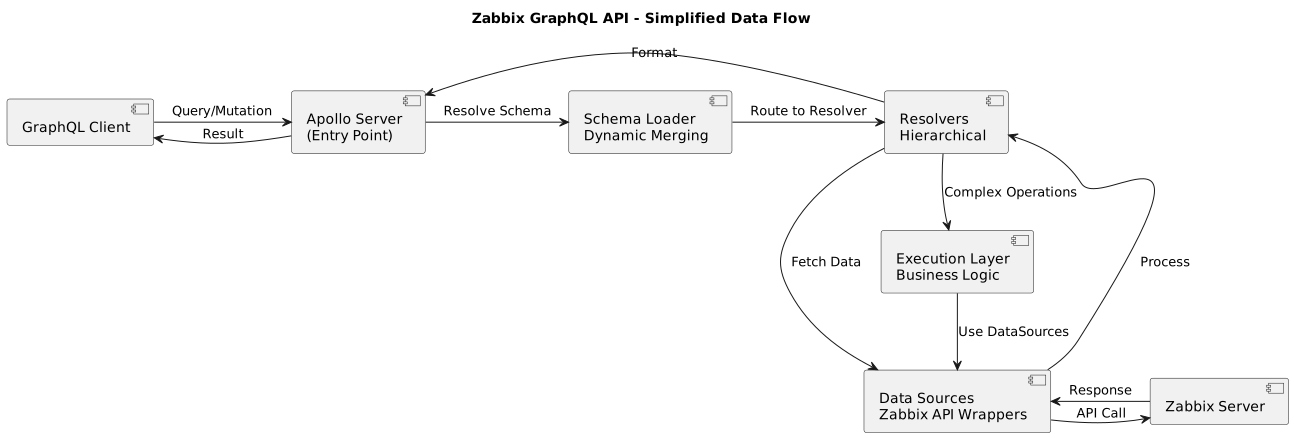
```PlantUML
@startuml
title Zabbix GraphQL API - Simplified Data Flow
[GraphQL Client] as client
[Apollo Server\n(Entry Point)] as server
[Schema Loader\nDynamic Merging] as schema
[Resolvers\nHierarchical] as resolvers
[Data Sources\nZabbix API Wrappers] as datasources
[Zabbix Server] as zabbix
[Execution Layer\nBusiness Logic] as execution
client -> server : "Query/Mutation"
server -> schema : "Resolve Schema"
schema -> resolvers : "Route to Resolver"
resolvers -> datasources : "Fetch Data"
datasources -> zabbix : "API Call"
zabbix -> datasources : "Response"
datasources -> resolvers : "Process"
resolvers -> server : "Format"
server -> client : "Result"
resolvers --> execution : "Complex Operations"
execution --> datasources : "Use DataSources"
@enduml
```
### Core Components
- **Entry Point**: `src/index.ts` → `src/api/start.ts` (Apollo Server setup)
- **Schema Loading**: `src/api/schema.ts` - Dynamic schema merging with extensibility via environment variables
- **Resolvers**: `src/api/resolvers.ts` + dynamic hierarchical resolvers via `resolver_helpers.ts`
- **DataSources**: `src/datasources/` - Zabbix API wrappers extending `RESTDataSource`
- **Execution**: `src/execution/` - Complex business logic (importers, deleters)
### Data Flow
1. **Client Request**: GraphQL queries/mutations arrive at the Apollo Server
2. **Schema Resolution**: Schema loader merges base schema with additional schemas (if configured)
3. **Resolver Execution**: Resolvers handle the request, using data sources to communicate with Zabbix
4. **Zabbix Communication**: Data sources make API calls to the Zabbix server
5. **Response Processing**: Results are processed and returned to the client
### DataSources Structure
The `src/datasources/` directory contains specialized Zabbix API wrappers:
- `zabbix-api.ts`: Main Zabbix API class extending `RESTDataSource`, handles authentication and communication
- `zabbix-{entity}.ts`: Specialized request classes for specific Zabbix entities (e.g., hosts, templates, etc.)
- Each DataSource follows the pattern of extending `ZabbixRequest` for type-safe API calls
### Key Architectural Patterns
#### 1. Hierarchical Data Mapping
Automatic mapping of Zabbix items/tags to GraphQL nested objects:
- Zabbix item key `state.current.values.temperature` → GraphQL `{ state: { current: { values: { temperature } } } }`
- Implemented via `createHierarchicalValueFieldResolver()` in `resolver_helpers.ts`
- Type hints: `json_`, `str_`, `bool_`, `float_` prefixes for value conversion
#### 2. Dynamic Schema Extension (No-Code)
Configure via environment variables:
```bash
ADDITIONAL_SCHEMAS=./schema/extensions/display_devices.graphql,./schema/extensions/location_tracker_devices.graphql
ADDITIONAL_RESOLVERS=SinglePanelDevice,FourPanelDevice,DistanceTrackerDevice
```
#### 3. Mass Import/Export Pattern
All importers follow hierarchy-first approach:
- **Host Groups**: Process parent groups before children (`getHostGroupHierarchyNames()`)
- **Template Dependencies**: Handle dependent items via deferred creation logic
- **Batch Processing**: Each importer returns array of `Response` objects with success/error details
#### 4. Permission System
Uses Zabbix template groups as permission containers:
- Template groups with prefix `Permissions/` (configurable via `ZABBIX_PERMISSION_TEMPLATE_GROUP_NAME_PREFIX`)
- Queries: `hasPermissions()`, `userPermissions()` in resolvers
- Integration: `ZabbixRequestWithPermissions` wrapper class
## 📄 License
This project is licensed under the AGPL-3.0 License - see the [LICENSE](LICENSE) file for details.
## 📚 Schema and Documentation
### Schema Files as Documentation
The schema files in the `schema/` directory serve as both API definition and documentation. Each type, field, and operation includes detailed comments explaining usage, parameters, and examples. For comprehensive understanding of the API, read the comments in:
- `schema/queries.graphql` - Query operations with detailed parameter descriptions
- `schema/mutations.graphql` - Mutation operations with input type documentation
- `schema/api_commons.graphql` - Common types and permission system documentation
- `schema/devices.graphql` - Device-related types and hierarchies
- `schema/zabbix.graphql` - Zabbix-specific mappings and types
### Documentation Files
The `docs/` directory contains sample GraphQL queries and mutations that demonstrate how to use the API:
- `sample_all_*.graphql` - Sample queries for retrieving hosts, devices, templates, and groups
- `sample_import_*.graphql` - Sample mutations for importing various Zabbix entities
- `sample_delete_*.graphql` - Sample mutations for deleting templates and template groups
- `sample_export_*.graphql` - Sample queries for exporting user rights and other data
- `VCR - Technical product information.pdf` - Technical documentation for specific implementations
Of particular interest:
- `sample_import_distance_tracker_template.graphql` - Complete example of importing a template for distance tracker devices
- `sample_import_user_rights_mutation.graphql` - Example of importing user permissions
- `sample_import_permissions_template_groups_mutation.graphql` - Example of importing permission template groups
### Reading Comments for Detailed Documentation
For detailed documentation with usage examples and implementation notes, read the comments in the schema and documentation files. The project creator has embedded extensive documentation as comments in the GraphQL schema files, which provide real-world usage examples and implementation guidance that complement this README.
## 🆘 Support
For support, please open an issue in the GitHub repository.
## 🔄 API Version
Current API version: ${API_VERSION:-"Not set"}
The API version is automatically set during the Docker build process based on the Git tag or commit hash. During CI/CD deployment (as defined in `.forgejo/workflows/deploy-docker.yaml`), the API_VERSION is determined using `git describe --tags --always`, which creates a version identifier based on the most recent Git tag and the number of commits since that tag. This version information is then embedded into the Docker image as a build argument and becomes accessible through the API_VERSION environment variable at runtime.
### Zabbix Version Compatibility
This API is designed to work with Zabbix 7.4, which is the version it runs productively with. The API wraps the Zabbix 7.4 API and has been tested extensively with this version. While it may work with other Zabbix versions, 7.4 is the officially supported and tested version.